On
Board
Narrowboat "FRILFORD"
(British Waterways No. 500645)
CHAPTER
FIFTEEN - "Failed the Dead Cow but Captured Mighty Dragons"
7th
- 8th July '05
The
charms of Selby passed me by. More accurately I passed them by. I
did not see Selby Abbey and the Washington Window containing the Heraldic
arms of the Washington family, which is to be found in the south clerestory
window of the choir and is the original fourteenth century glass.
Arriving, as I did, on a Wednesday afternoon and leaving again early
on the Thursday morning I did not see the town's market, which is
held on Mondays and draws crowds from the surrounding area.  Selby
retains its role as an important market for local farmers with the
modern livestock market being held every Friday and Saturday mornings
so I missed those too. Indeed I was not aware that Selby had recently
been voted one of the top five places in the UK to live. Selby
retains its role as an important market for local farmers with the
modern livestock market being held every Friday and Saturday mornings
so I missed those too. Indeed I was not aware that Selby had recently
been voted one of the top five places in the UK to live.
Selby’s
massive industrial heritage was kept from me, as it is hidden to all
boaters casually navigation the waterways of Yorkshire. Nicholson’s
Guide for the area reminds us that below those waterways was the biggest
coal mining complex in Europe and that it is only the effects of subsidence
which reminds us of the extensive activity which took place below.
The mines in the area provided work for some 4000 people and some
11 million tons of coal was extracted from shafts sunk in the 1960s
and 1970s at a cost of some 1 billion pounds. The shafts extend eastwards
towards the North Sea at a depth of 700 feet. Some of the coal seams
extend two to three miles in length. And how did the most modern and
productive complex in Europe choose to transport its product? At one
of its collieries it chose the cleanest and most environmentally-friendly
means. It moved coal on the canal. In 1996 Kellingly Colliery celebrated
having moved 35 million tons by barge to Ferrybridge Power Stations.
How long, I wonder, before industry looks to the canal system once
again to move products? Moving around the system, I have, one cannot
help but he struck by the renewed potential for the movement of non-time
essential good on the canal. Obviously Tesco won’t move their
on-line shopping products by canal (“Thank you for your order,
Madam. We do indeed have your favourite cream cakes in stock and they,
together with your fresh veg and dairy produce, have been loaded onto
a barge in Runcorn and should be with you in Richmond a fortnight
on Thursday. Thank you for shopping with Tesco On-Line!”) but
building materials, newsprint, animal feed etc etc – surely
we can get that stuff off the roads and back onto the canals. Can’t
we?
 None
of this impacted upon me that Thursday morning in Selby, as I had
to get up the tidal River Ouse to Naburn and had to make an early
start. I was up by 6.30 am and was ready to go by just after 7.00
am. The lockkeeper was around by then and came to tell me that he’d
lock me through as soon as I was ready to go. I fired up FRILFORD’s
engine and was in Selby Lock by 7.40 am. None
of this impacted upon me that Thursday morning in Selby, as I had
to get up the tidal River Ouse to Naburn and had to make an early
start. I was up by 6.30 am and was ready to go by just after 7.00
am. The lockkeeper was around by then and came to tell me that he’d
lock me through as soon as I was ready to go. I fired up FRILFORD’s
engine and was in Selby Lock by 7.40 am.
What a morning.
The wind was blowing a gale and the rain was coming down in sheets;
sheets which exploded in the air as the wind threw them this way and
that. I’d already had a look at the river. Again it was going
like mad. Brown, turbulent water rushed past the lower gates of Selby
Lock and off under various bridges to the north. Large objects were
being carried along in the tide and the wind ripped small brown ‘white’
horses off the top off the surface. Was I really going to push FRILFORD
out into that lot? It seems I was.
Selby Lock is
quite deep and I allowed myself a fanciful moment as the lockkeeper
dropped FRILFORD and me down to river level – I am sinking into
hell! The lockkeeper was pleasant enough, if a bit matter-of-fact.
He gave me a couple of ‘phone numbers to ring if I got into
trouble and advised me that there was no rescue service operating,
but if I got into difficulties I was to anchor and wait for assistance
as they would advise passing traffic that I was there and would need
assistance! Right… At that stage I didn’t realise how
close I was coming to having ‘difficulties’…
 The
water in the lock was down and the lockkeeper opened the bottom gates.
The River Ouse was careering past, right to left. I imagined there
might be other boats making this passage with me, but no, I was on
my own. “Don’t steer to the left,” advised the lockkeeper,
“just move slowly out of the lock and let the river turn your
bows. After that you can move off. Take the right-hand arches under
the two bridges up there if you can, but if you get swept through
the left-hand ones it’ll be okay today – you are the only
traffic at the moment. You’ll be okay anyway.” I took
his advice and moved slowly out of Selby Lock. Sure enough I was only
one boat length out of the lock when FRILFORD was swung to the left
and started moving off with the tidal current. I looked back at the
lockkeeper, smiled, he waved, I looked away, opened the throttle and
we were off! The
water in the lock was down and the lockkeeper opened the bottom gates.
The River Ouse was careering past, right to left. I imagined there
might be other boats making this passage with me, but no, I was on
my own. “Don’t steer to the left,” advised the lockkeeper,
“just move slowly out of the lock and let the river turn your
bows. After that you can move off. Take the right-hand arches under
the two bridges up there if you can, but if you get swept through
the left-hand ones it’ll be okay today – you are the only
traffic at the moment. You’ll be okay anyway.” I took
his advice and moved slowly out of Selby Lock. Sure enough I was only
one boat length out of the lock when FRILFORD was swung to the left
and started moving off with the tidal current. I looked back at the
lockkeeper, smiled, he waved, I looked away, opened the throttle and
we were off!
The absolute simplicity
and efficiency of the way FRILFORD had reacted as I came out of the
lock, exactly how the lockkeeper said she would gave me confidence
and I busied myself with getting through the right-hand arches of
the Railway and Road Swing Bridges. I reckoned the tide was running
at about 4.5 miles an hour. According to my GPS I was making 8.4 mph
over the ground. I had almost 1500 rpm set which on flat water would
have given me about 3.5 to 4.0 mph. I’d only just left the lock!
After the bridges
the river takes a sharp turn to the right and takes what is virtually
an easterly course and not long after that swings north. The wind
was coming from the north. The tide was underneath me, thus from the
south. Wind over tide! Yup, choppy.  Sailing
people and boaters generally will know that if a tide or current is
going one way and the wind is blowing another the wind piles the water
up into short, steep waves and blows the tops off them! So it was
on the mile or so straight to the next bend. Classic wind over tide.
I kept FRILFORD at about 1500 rpm and pushed on through the lively
water at about 9 to 10 mph ground speed. Control was a bit sluggish
so I did not want to go any faster, although I could have gone quite
a bit faster. I needed control. The flotsam and jetsam I’d seen
from the lock sides turned out to be every sort of detritus you can
imagine, together with large branches of great trees; a whole tree
in one case! And I had to be able to steer round it, albeit that our
speed differential was not great. I passed (well, hardly passed, this
stuff was almost keeping pace with me in places!) sofas, gas canisters
of various sizes, car tyres too numerous to count, pallets, packing
cases, a huge cable reel. And a dead sheep, lying serenely on its
back, its hind legs pointing straight in the air like some sort of
curiously-rigged sailing vessel. Sailing
people and boaters generally will know that if a tide or current is
going one way and the wind is blowing another the wind piles the water
up into short, steep waves and blows the tops off them! So it was
on the mile or so straight to the next bend. Classic wind over tide.
I kept FRILFORD at about 1500 rpm and pushed on through the lively
water at about 9 to 10 mph ground speed. Control was a bit sluggish
so I did not want to go any faster, although I could have gone quite
a bit faster. I needed control. The flotsam and jetsam I’d seen
from the lock sides turned out to be every sort of detritus you can
imagine, together with large branches of great trees; a whole tree
in one case! And I had to be able to steer round it, albeit that our
speed differential was not great. I passed (well, hardly passed, this
stuff was almost keeping pace with me in places!) sofas, gas canisters
of various sizes, car tyres too numerous to count, pallets, packing
cases, a huge cable reel. And a dead sheep, lying serenely on its
back, its hind legs pointing straight in the air like some sort of
curiously-rigged sailing vessel.
“Be a bit
careful on the bend at Turn Head.” was another piece of advice
the lockkeeper at Selby had given as I was locking through. “You’ll
be okay but the water moves quite fast round there. After that you’re
fine…” Turn Head is at the end of the northerly wind-over-tide
straight and turns sharply, really very sharply, to the left. I approached
it going a fair old lick; I had no choice.  As
I closed the bend I could see there was what appeared to be quite
a back eddy coming round the outside of the bend and that where the
back eddy and the tide came together the water was choppy and disturbed.
I planned to keep out of that but as I entered the bend I could see
that the chop was right in the middle of the river and that various
large branches were snagged on the left-hand bank, the inside of the
bend. As I turned the bend FRILFORD slid into the chop on the edge
of the back eddy. For a moment I though we would capsize! FRILFORD
heeled over at such an angle I had to grap the hatch combing to steady
myself. For a lifetime lasting about two seconds FRILFORD was well
over on her starboard side. Memories of that stupid incident in Henley
on Thames, when I nearly capsized her because of my own foolishness,
flashed through my mind. From below came crashing sounds as various
things rolled off surfaces and fell on the floor. Then, in what was
hardly more than the blink of an eye FRILFORD rolled upright again
and continued hurtling along the river. All was well! As
I closed the bend I could see there was what appeared to be quite
a back eddy coming round the outside of the bend and that where the
back eddy and the tide came together the water was choppy and disturbed.
I planned to keep out of that but as I entered the bend I could see
that the chop was right in the middle of the river and that various
large branches were snagged on the left-hand bank, the inside of the
bend. As I turned the bend FRILFORD slid into the chop on the edge
of the back eddy. For a moment I though we would capsize! FRILFORD
heeled over at such an angle I had to grap the hatch combing to steady
myself. For a lifetime lasting about two seconds FRILFORD was well
over on her starboard side. Memories of that stupid incident in Henley
on Thames, when I nearly capsized her because of my own foolishness,
flashed through my mind. From below came crashing sounds as various
things rolled off surfaces and fell on the floor. Then, in what was
hardly more than the blink of an eye FRILFORD rolled upright again
and continued hurtling along the river. All was well!
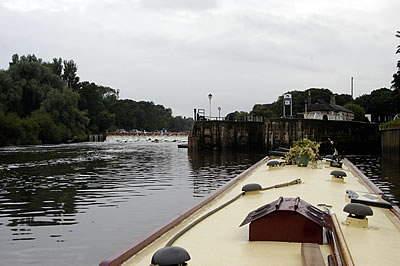
The Swing Bridge
at Cawood is a staging post for the trip from Selby to Naburn. Not
that one can stop there: there is nowhere to stop between Selby and
Naburn. The tide is too strong and the banks are steep and wooded.
Indeed there is little to see on the banks. On either side there are
flood plains and rich farmland. What towns and villages there are
in the area are well back from the river. The Cawood Swing Bridge
hove into view and I passed under the right-hand arch. I looked back
to the control office perched atop the bridge. I wondered if there’d
be someone there to monitor my passing. Perhaps there was (there was
on the way back a few weeks later) but I did not see them. Never mind
– I was making good progress. It was just before 9.00 am, I
had been on the river for just over an hour and already had done nearly
nine miles: a resonable day's mileage on The Cut!
 The
rain had long stopped. I think it stopped soon after I left Selby
Lock, in fact, but I was rather preoccupied with everything that was
going on and did not notice. The sun had been trying to push through
the clouds but it failed and the day was lit by grey leaden skies.
I was still heavily involved in the business of dodging the flotsam
and jetsam, which was everywhere, but it was less severe now. Still
lots of branches, with masses of weed and general river junk trapped
all around, but the sofas, gas canisters and dead sheep had slipped
further behind. As I headed towards Naburn the effect of the tide
decreased and I thought of opening the throttle to keep our good ground
speed going. I didn’t, however. As we went north the river was
getting smaller and I needed to concentrate. Bravado at this point
would not have been the thing. Anyway – it was still early morning
and I was not in a hurry. The
rain had long stopped. I think it stopped soon after I left Selby
Lock, in fact, but I was rather preoccupied with everything that was
going on and did not notice. The sun had been trying to push through
the clouds but it failed and the day was lit by grey leaden skies.
I was still heavily involved in the business of dodging the flotsam
and jetsam, which was everywhere, but it was less severe now. Still
lots of branches, with masses of weed and general river junk trapped
all around, but the sofas, gas canisters and dead sheep had slipped
further behind. As I headed towards Naburn the effect of the tide
decreased and I thought of opening the throttle to keep our good ground
speed going. I didn’t, however. As we went north the river was
getting smaller and I needed to concentrate. Bravado at this point
would not have been the thing. Anyway – it was still early morning
and I was not in a hurry.
At about 9.40
am a couple of narrowboats passed me going the other way. They had
been released by the lockkeeper at Naburn to take advantage of the
turning tide on their trip back to Selby. We waved at each other but
nothing was said. They knew they were in for a lively time and that
I was just finishing one!
I got to Naburn
Lock at ten to ten. I was not quite sure what to do so I 'phoned the
lockkeeper as I approached. “Oh – you here already? Okay…”
was his response. There are two locks at Naburn, next to a big weir,
but only one seems to be working. I chatted to the lockkeeper whilst
locking up and we talked about the amount of F & J in the water.
“We’ve been up and down the river clearing out the bywashes
and the weir, getting rid of the dead trees and things,” he
said. “We capture as much as we can but a lot gets away. It’ll
gradually clear. Did you see the dead cow?” I said I hadn’t
but that I’d seen a dead sheep! “Nah – you missed
the dead cow: it’s out there somewhere still, I understand,
quite a big un’ it is.” “No,” I said, “I
saw the sheep…” It seems that in dead-animal-in-the-river
currency sheep are small change compared to cows. My river cred was
down a bit, having missed the dead cow. Hope I see it on the way back!
In no time I passed
through the top gates and tied up on a very pleasant mooring just
the other side at the far end of the basin, under some trees. 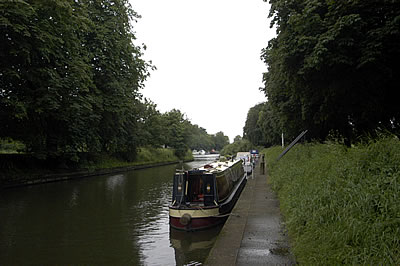 I
secured my lines and turned off the engine. I’d done 14.3 miles
that morning and it was still only quarter past ten! I
secured my lines and turned off the engine. I’d done 14.3 miles
that morning and it was still only quarter past ten!
I fiddled about
for a bit then put the radio on. Something must have happened. Radio
Four seemed to have some sort of rolling news programme on. There
was talk of some explosions or something in London. Not much detail.
It was 7th July and ‘home grown’ (we were to learn later)
terrorists had attacked Underground stations in London. I listened
for a few hours. I admire so much those broadcasters who are at their
post when major incidents occur. One minute they are following the
basic script mapped out for the programme they are presenting. The
next minute, unscripted, they and the production team are trying to
weave a pattern of cogent news and information out of information
gleaned by harassed reporters running around trying to report on something
about which they know next to nothing, talking to people who know
little and who are saying less.
I tried to call
my father. Reports on the radio said that mobile phone services had
collapsed in London as the system could not cope with the call volume.
Many of England’s people were, no doubt, trying to call each
other to check on their whereabouts. I didn’t want to add to
the traffic but I’d got it into my head that Father had been
going to London that day to some sort of RAF reunion. I called and
called but either his line was engaged or I could not get through.
I phoned my sister. Couldn’t get her either. When I did get
her she had not spoken to Father and was unaware that he might be
in London. Eventually I did get hold of Father. He hadn’t gone
to London – he was due to go on Sunday and had been calling
around his various contacts to find out what they may or may not being
doing about their trip on Sunday. He was fine.
 Later
I took at call from someone who I have known for twenty-five years
and from whom I have never taken a telephone call before. It was the
wife of my Norwegian boss from my days in Singapore in the early 1980s.
She was calling from Norway. “Hello, Adrian, how are you?”
“Well, I’m fine, thank you. How marvellous to hear from
you. How are you both?” (I am withholding names here…).
“Oh, we’re fine, thanks. How is your boat?” “Er,
fine too. Bit shaken by the news from London, though. Have you heard?”
“Well yes, Adrian, that’s why we’re calling…
we can’t get hold of our daughter. Is there a number we can
ring – or do you have the number for the Norwegian Embassy?”
“Not on me, no – there is a number; they’ve been
giving it out on the radio. I’ll get it and call you back.”
“Oh, thank you Adrian. So where are you now?” The lady
is the most wonderful, charming, statesman-like person. As an ex-pat
of some fifty-plus years standing, both in India and Singapore, in
support of her husband, she knows how to be in all situations. She
was trying to be affable on what was clearly a difficult day for her.
“I’m near York in the north of Engand, but never mind
that. If you’ll excuse me, let me help you now and we can talk
another time.” “Oh, yes, Adrian – exactly. Thank
you.” Later
I took at call from someone who I have known for twenty-five years
and from whom I have never taken a telephone call before. It was the
wife of my Norwegian boss from my days in Singapore in the early 1980s.
She was calling from Norway. “Hello, Adrian, how are you?”
“Well, I’m fine, thank you. How marvellous to hear from
you. How are you both?” (I am withholding names here…).
“Oh, we’re fine, thanks. How is your boat?” “Er,
fine too. Bit shaken by the news from London, though. Have you heard?”
“Well yes, Adrian, that’s why we’re calling…
we can’t get hold of our daughter. Is there a number we can
ring – or do you have the number for the Norwegian Embassy?”
“Not on me, no – there is a number; they’ve been
giving it out on the radio. I’ll get it and call you back.”
“Oh, thank you Adrian. So where are you now?” The lady
is the most wonderful, charming, statesman-like person. As an ex-pat
of some fifty-plus years standing, both in India and Singapore, in
support of her husband, she knows how to be in all situations. She
was trying to be affable on what was clearly a difficult day for her.
“I’m near York in the north of Engand, but never mind
that. If you’ll excuse me, let me help you now and we can talk
another time.” “Oh, yes, Adrian – exactly. Thank
you.”
Thanks to the
power of the internet it took no time at all to get the incident information
number and the number of the Norwegian Embassy. I called the Embassy
to check that they would be able to help if a Norwegian was to call
asking for assistance. The charming woman on the other end of the
line said they were getting calls and would be pleased to help. I
called back to the lady in Norway, gave her the numbers and told her
I’d be thinking of her and her daughter in London. She said
she’d call me back when she had news.
I got on my bike
and rode into York, some six or seven miles away. By now the sun was
shining and the splendid city that is York was putting on a bit of
a show. I jostled about in the charming back streets with the tourists
then went to York Minster. It was packed with tourists and whilst
I would have liked to wander round I was really there to find out
about services. I discovered there was to be a choral evensong in
the choir at 5.00 pm.
I used to be a
treble chorister at New College in Oxford in the later 1960s. It was
then, as now, one of the top choirs in the UK. If anyone knows anything
about choirs in the UK they have heard of Kings College Choir Cambridge,
if nothing else for the traditional service of Nine Lessons and Carols
broadcast live in the UK by the BBC every Christmas.  During
my time at New College we were always described as one of the two
best choirs in England, together with Kings. We knew we were better
than Kings but they had a much better publicity machine! Not now,
it seems. Now there are recordings of New College Choir to be found
everywhere, some of them making “Best CD of something, something,
something….” Or whatever. In our days we recorded for
Abbey Records, a modest local company who knocked out a few pressings
of our vinyl LPs and EPs. Indeed, I have a few dog-eared LPs somewhere
(the sleeves are dog-eared – the LPs are just scratched!) of
‘our’ choir singing, one of which has my name on the back!
At the time I was in the choir most of the trebles were of a similar
age so I did not progress up the ranks too far. I made number seven
on Cantoris side, out of eight. Towards the end of my singing career
my voice was breaking, and whilst I could still sing treble I could
also sing a sort of honking bass! I did not sing solos, but I was
there, and enjoyed the most magical of musical experiences. I had
no idea of what an experience it was at the time, but I know now,
for occasionally I slip into cathedrals round the country for choral
evensong and relive it. Movingly. During
my time at New College we were always described as one of the two
best choirs in England, together with Kings. We knew we were better
than Kings but they had a much better publicity machine! Not now,
it seems. Now there are recordings of New College Choir to be found
everywhere, some of them making “Best CD of something, something,
something….” Or whatever. In our days we recorded for
Abbey Records, a modest local company who knocked out a few pressings
of our vinyl LPs and EPs. Indeed, I have a few dog-eared LPs somewhere
(the sleeves are dog-eared – the LPs are just scratched!) of
‘our’ choir singing, one of which has my name on the back!
At the time I was in the choir most of the trebles were of a similar
age so I did not progress up the ranks too far. I made number seven
on Cantoris side, out of eight. Towards the end of my singing career
my voice was breaking, and whilst I could still sing treble I could
also sing a sort of honking bass! I did not sing solos, but I was
there, and enjoyed the most magical of musical experiences. I had
no idea of what an experience it was at the time, but I know now,
for occasionally I slip into cathedrals round the country for choral
evensong and relive it. Movingly.
I was not dressed
for evensong that night. My bike was chained up outside the Minster
and I was in jeans, tee-shirt and a rough jacket. I am the sort of
person who likes to dress up to go to church. It’s a respect
thing. I know the thinking today is that it does not matter how one
is dressed; the important thing is to be there. The Lord loves you
as you are.  I
know, but when I worship I like to move onto a slightly higher intellectual
plane and making that an occasion by dressing up a bit is all part
of it. For me, anyway. Not for nothing do Oxford University examinees
have to dress in gown and mortar board when taking exams. Indeed,
when I did my A levels at Abingdon School in 1973, shunning the order
of the day which allowed us to wear casual mufti (which did mean jeans
and tee-shirt in that case, I seem to remember – forbidden at
other times!) I wore my Sunday-best suit. Not my everyday suit, mark
you, my Sunday suit. Not sure what difference it made – a C
and an E in English and History (I’d dropped Economics at the
suggestion of the Economics tutor, mine being a hopeless case!) does
not suggest a level of high sartorial elegance, but just imagine what
my grades might have been had I not put my suit on! Anyway, notwithstanding
my dress I decided to attend evensong. I spent the hour beforehand
in a café around the corner and went back into the Minster
at about twenty to five. This gave me a chance to walk around the
place and take in its magnificence. There has been a Christian community
in York from the time of the Roman Occupation. By the year 314 York
already had its own bishop and the church deemed to be the first York
Minster was in place on the site by 625, when Edwin, the pagan king
of Northumbria was christened there together with his court in a small
church made of wood, especially erected for the occasion. Building
of the Minster as we know it today started in 1220 and went on, in
one form or another, for the next 250 years. I
know, but when I worship I like to move onto a slightly higher intellectual
plane and making that an occasion by dressing up a bit is all part
of it. For me, anyway. Not for nothing do Oxford University examinees
have to dress in gown and mortar board when taking exams. Indeed,
when I did my A levels at Abingdon School in 1973, shunning the order
of the day which allowed us to wear casual mufti (which did mean jeans
and tee-shirt in that case, I seem to remember – forbidden at
other times!) I wore my Sunday-best suit. Not my everyday suit, mark
you, my Sunday suit. Not sure what difference it made – a C
and an E in English and History (I’d dropped Economics at the
suggestion of the Economics tutor, mine being a hopeless case!) does
not suggest a level of high sartorial elegance, but just imagine what
my grades might have been had I not put my suit on! Anyway, notwithstanding
my dress I decided to attend evensong. I spent the hour beforehand
in a café around the corner and went back into the Minster
at about twenty to five. This gave me a chance to walk around the
place and take in its magnificence. There has been a Christian community
in York from the time of the Roman Occupation. By the year 314 York
already had its own bishop and the church deemed to be the first York
Minster was in place on the site by 625, when Edwin, the pagan king
of Northumbria was christened there together with his court in a small
church made of wood, especially erected for the occasion. Building
of the Minster as we know it today started in 1220 and went on, in
one form or another, for the next 250 years.
The choir sang
Stanford that evening. They sang beautifully and I was much moved.
The bike ride back to FRILFORD at Naburn passed in a blur as I relived
the service and all the choral evensongs I had sung at New College
nearly 40 years ago. Wonderful.
 The
next day, 8th July, broke clear and bright and I prepared to move
up the river to York. I have said this before but one has to listen
to, and consider, a lot of local ‘advice’ when on the
waterways, most of it, in my experience, obviously born of personal,
and untypical, experience. “Don’t moor in York!”
That was the advice I had been given by more than one person. “There
are not much in the way of moorings and that which there are are exposed
and not very safe.” In the past I had heard bad things about
going through Leicester and that had not been a problem. I had heard
bad things about navigating on the Erewash Canal, and that had not
been a problem. I had been told I’d need crew assistance to
get over the Huddersfield Narrow Canal, and I had not. I am not being
foolhardy here. I am pleased to take advice but sometimes one hears
things which just don’t bear out in reality. The
next day, 8th July, broke clear and bright and I prepared to move
up the river to York. I have said this before but one has to listen
to, and consider, a lot of local ‘advice’ when on the
waterways, most of it, in my experience, obviously born of personal,
and untypical, experience. “Don’t moor in York!”
That was the advice I had been given by more than one person. “There
are not much in the way of moorings and that which there are are exposed
and not very safe.” In the past I had heard bad things about
going through Leicester and that had not been a problem. I had heard
bad things about navigating on the Erewash Canal, and that had not
been a problem. I had been told I’d need crew assistance to
get over the Huddersfield Narrow Canal, and I had not. I am not being
foolhardy here. I am pleased to take advice but sometimes one hears
things which just don’t bear out in reality.
I consulted Nicholson
on the subject. There is no talk there of poor or unsafe moorings.
Indeed with typical candour Nicholson shows a small grey box on the
map of York in which are the words ‘MOORING The most satisfactory
pleasure craft moorings are between Scarborough Bridge and Lendal
Bridge.’ Simple, clear, straightforward advice – and absolutely
correct. As, now, a veteran of several weeks there, on and off, I
can attest to that. Very good moorings, right in the centre of town,
right opposite the very active, very successful City of York Rowing
Club and safe. Well, safe-ish…
Before setting
off from Naburn on the Friday I did my usual engine checks, only this
time I was a little more thorough. I’d been pushing FRILFORD
a bit over the past few weeks and I thought I’d have a good
look round. Normally I just check the oil and cooling water levels,
and see that the alternator belt is okay, and that’s it. 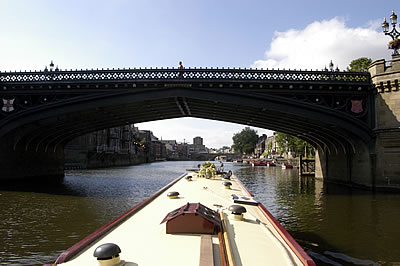 On
that day I looked further, particularly looking to see what had been
done about the chafing problem on the top cooling hose mentioned in
the surveyor’s report when I bought FRILFORD. Nothing! That
is to say nothing had been done about the chafing problem. I thought
I’d asked the yard at Eynsham to look at it. I probably hadn't
because they obviously had not! Never mind; they’d done a host
of other stuff and I should have checked the hose well before now.
So it was my fault that the thing was virtually through in a hole!
It had been rubbing against some formwork in the engine compartment,
just as the surveyor had said in his report, and was now on the point
of leaking. It would not have been a leak, of course. A hole there
would have meant the engine would have pumped itself dry of cooling
water in no time. It would have overheated and I’d’ve
had to stop. Now had this happened the day before on the River Ouse,
in high wind and rain with a 5 mph tide under the hull…. It
would have made for a not-much-fun day. As it was Someone was on my
side, for there is a boatyard and good chandlery in Naburn and I was
able to get a bit of hose to replace the old one. Not the right bit
of hose, but a reinforced fuel hose which I was able to fit without
too much trouble and which is still in place, unchaffed, to this day.
It pays to go to church occasionally. Just to get your card punched,
as it were… On
that day I looked further, particularly looking to see what had been
done about the chafing problem on the top cooling hose mentioned in
the surveyor’s report when I bought FRILFORD. Nothing! That
is to say nothing had been done about the chafing problem. I thought
I’d asked the yard at Eynsham to look at it. I probably hadn't
because they obviously had not! Never mind; they’d done a host
of other stuff and I should have checked the hose well before now.
So it was my fault that the thing was virtually through in a hole!
It had been rubbing against some formwork in the engine compartment,
just as the surveyor had said in his report, and was now on the point
of leaking. It would not have been a leak, of course. A hole there
would have meant the engine would have pumped itself dry of cooling
water in no time. It would have overheated and I’d’ve
had to stop. Now had this happened the day before on the River Ouse,
in high wind and rain with a 5 mph tide under the hull…. It
would have made for a not-much-fun day. As it was Someone was on my
side, for there is a boatyard and good chandlery in Naburn and I was
able to get a bit of hose to replace the old one. Not the right bit
of hose, but a reinforced fuel hose which I was able to fit without
too much trouble and which is still in place, unchaffed, to this day.
It pays to go to church occasionally. Just to get your card punched,
as it were…
I don’t
consider myself much of a mechanic but I was pleased with the way
this job went. I topped up the cooling system with water, some of
it having been lost during the work, and ran the engine for half an
hour. Quite why I expected the temperature gauge to leap off the top
of the scale and for the engine to collapse molten into the bottom
of the boat I don’t know. Neither of these things happened and
before long I was making ready to go to York, dire mooring warnings
or no.
 Before
I left the lady from Norway rang again. After quite a number of phone
calls involving the Norwegian Embassy in London she’d found
her daughter who, although she has a house in London not far from
where the bombs had gone off, was travelling that day and was not
in town. And was fine. Now I was able to have a long chat with the
woman during the course of which she flattered me more than I can
remember being flattered. She told me that at her grand old age, and
having lived an international life for so many years, she knows literally
hundreds of well-connected people all around the world, yet when she
wanted someone to help her with some information in a straightforward
unflappable way she though, so she told me, of phoning just one person.
Adrian Rayson. “I know so many people who would have got all
alarmed and fretful,” she said, “and I’d’ve
ended up reassuring them… I knew I could rely on you, Adrian.
You were calm and efficient and did exactly what I asked of you without
fuss – and I thank you.” I felt very appreciated, which,
wrongly perhaps, I don’t feel very often. It pays to go to church
occasionally, maybe. Before
I left the lady from Norway rang again. After quite a number of phone
calls involving the Norwegian Embassy in London she’d found
her daughter who, although she has a house in London not far from
where the bombs had gone off, was travelling that day and was not
in town. And was fine. Now I was able to have a long chat with the
woman during the course of which she flattered me more than I can
remember being flattered. She told me that at her grand old age, and
having lived an international life for so many years, she knows literally
hundreds of well-connected people all around the world, yet when she
wanted someone to help her with some information in a straightforward
unflappable way she though, so she told me, of phoning just one person.
Adrian Rayson. “I know so many people who would have got all
alarmed and fretful,” she said, “and I’d’ve
ended up reassuring them… I knew I could rely on you, Adrian.
You were calm and efficient and did exactly what I asked of you without
fuss – and I thank you.” I felt very appreciated, which,
wrongly perhaps, I don’t feel very often. It pays to go to church
occasionally, maybe.
I left Naburn
just before 4.00 pm, passed the Archbishop of York’s Palace
at Bishopthorpe at 4.36 and was tied up along the wall in York, right
opposite the rowing club, at about 5.30 pm. It was (and still is no
doubt) a lovely mooring. The rowing club had many boats out on the
river, the YorkBoat tourist boats were plying their trade, people
were walking up and down on the river banks and there was much feeding
of the ducks. FRILFORD’s engine had run beautifully with the
temperature gauge sitting just where it is supposed to. It would be
some time later that I would discover why it would have been very
reasonable for the engine to have seized up at any moment!
 Saturday
was a calm day spent enjoying York in warm summer sun. By now I was
chained to the mooring rings along the wall. I had noticed other boats
were chained up and on enquiry discovered that this was a useful precaution,
just to show the local youths that there was no fun to be had with
the boat. They had gathered on the benches above the moorings the
previous night but, apart from a bit of rowdiness, had gone away again
without incident. I had chains on board FRILFORD for just such an
occasion and had not used them before. I am keen to tell people that
although I have a host of gadgets and bits of gear on board FRILFORD,
all of it has a purpose and has been, or will be, used at some point! Saturday
was a calm day spent enjoying York in warm summer sun. By now I was
chained to the mooring rings along the wall. I had noticed other boats
were chained up and on enquiry discovered that this was a useful precaution,
just to show the local youths that there was no fun to be had with
the boat. They had gathered on the benches above the moorings the
previous night but, apart from a bit of rowdiness, had gone away again
without incident. I had chains on board FRILFORD for just such an
occasion and had not used them before. I am keen to tell people that
although I have a host of gadgets and bits of gear on board FRILFORD,
all of it has a purpose and has been, or will be, used at some point!
On Saturday late
evening the lads and lassies of the town again paraded, showed off
and generally gadded about, in a modern way, of course, along the
path above the moorings and again, apart from the lads making fools
of themselves, nothing untoward happened.  On
Sunday morning, however, I was woken early (and by early I mean just
after 7.00 am – and that is early for a Sunday!) by ever-increasing
noises of activity going on outside. I looked out of a porthole. Lots
of people, some wearing those high-visibility ‘tabard’
things, were setting up tables, erecting canvas gazebos, putting up
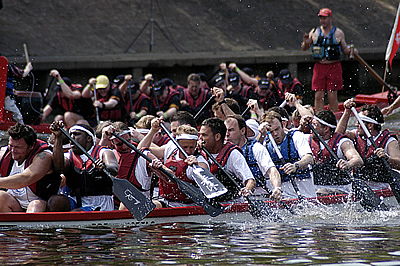
banners and generally making ready for some sort of event. Unbeknownst
to me I was right in the middle of what was to become that day the
2005 edition of York’s annual Great York Dragon Boat Challenge! On
Sunday morning, however, I was woken early (and by early I mean just
after 7.00 am – and that is early for a Sunday!) by ever-increasing
noises of activity going on outside. I looked out of a porthole. Lots
of people, some wearing those high-visibility ‘tabard’
things, were setting up tables, erecting canvas gazebos, putting up
banners and generally making ready for some sort of event. Unbeknownst
to me I was right in the middle of what was to become that day the
2005 edition of York’s annual Great York Dragon Boat Challenge!
I spoke to the
chap on the boat next to me who’d arrived in the middle of Saturday
afternoon. He laughed and could not understand that I knew nothing
of the event. “You’re moored right on the finish line,
in the best seat in the house and you didn’t know this was going
on?!” “No,” I replied, ”I’m on my way
up to Ripon – I’m just passing through!” “Well,
good for you! We got hear last night to bag a good spot, which we
have, of course… Will you stay for the fun?” “Certainly!”
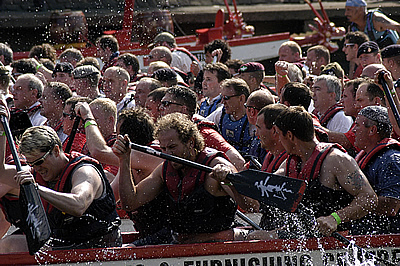 It
was fun too. About thirty or more boats, made up of all sorts of corporate
and sports club teams, including several from the Armed Forces, competed
in a series of knockout and repechage races to form a six boat final.
The races went on for most of the day and produced everything from
somewhat inept performances hampered by much laughing and probably-illegal
use of paddles for splashing the opposition, through to flat out,
neck-a’-neck racing. Several boats capsized to much applause
and ribaldry, and were rescued by highly-efficient rescue squads who
were omni-present on the river in a fleet of Zodiacs. It
was fun too. About thirty or more boats, made up of all sorts of corporate
and sports club teams, including several from the Armed Forces, competed
in a series of knockout and repechage races to form a six boat final.
The races went on for most of the day and produced everything from
somewhat inept performances hampered by much laughing and probably-illegal
use of paddles for splashing the opposition, through to flat out,
neck-a’-neck racing. Several boats capsized to much applause
and ribaldry, and were rescued by highly-efficient rescue squads who
were omni-present on the river in a fleet of Zodiacs.
York Rotary Club
organised the whole thing and from their website at http://www.yorkrotary.co.uk
I have nicked the following:
Results
1.The Challenge Trophy – Presented to the winner of the Major
Final - DST Deserters ( The Defence School of Transport)
2.Runners Up – Presented to the second team in the Major Final
- Mexican Bandits ( Flamborough RNLI )
Major Final
| Team |
Time
(mins.) |
| DST Deserters
(The Defence School of Transport) |
0.56.94 |
| Mexican Bandits
(Flamborough RNLI) |
0.57.29 |
| Dragon Slayers
(Harrison Construction) |
0.57.55 |
| Global Challenge
(H Todd & Son) |
0.57.75 |
| AFC Lions
(Army Foundation College) |
0.57.95 |
| The Growlers
(Ged Bell & Son) |
0.58.13 |
3. Fastest Armed
Forces team - DST Deserters (The Defence School of Transport), with
a time of 56.94 seconds, was presented with the Merlin Cup.
4. The award for the “Best Dressed Team” went to the Flying
Scotsman (GNER)
 Well
done York Rotary Club! It was a super day, well organised and, for
me in 2005, not a bad substitute for Henley Royal Regatta which I
had missed for the first time in a very long time. Indeed, having
Henley on Thames signwritten on the side of my boat a number of people
joked to me about comparing the Great York Dragon Boat Challenge with
HRR. It was completely different, of course, except that it was a
great day out on a river enjoyed by large, happy, crowds watching
hosts of boats being powered over a finish line attempting to win
a prestigious prize. So just the same, in fact! Well
done York Rotary Club! It was a super day, well organised and, for
me in 2005, not a bad substitute for Henley Royal Regatta which I
had missed for the first time in a very long time. Indeed, having
Henley on Thames signwritten on the side of my boat a number of people
joked to me about comparing the Great York Dragon Boat Challenge with
HRR. It was completely different, of course, except that it was a
great day out on a river enjoyed by large, happy, crowds watching
hosts of boats being powered over a finish line attempting to win
a prestigious prize. So just the same, in fact!
I took about 500
pictures which I burned onto a CD and sent to the Rotary Club. I got
a very nice reply from a chap called Colin who invited me to their
Friday lunch at a local hotel. It would have been good to go but,
unfortunately, I was away from York by then.
Away from York
because the next day, the Monday, I was to move off up the River Ouse,
which en route becomes the River Ure to Linton Lock, thence to Ripon
– my destination since setting out from Abingdon on 21st March.
Was it all coming
to an end? Hardly…
|